BOOK REVIEW
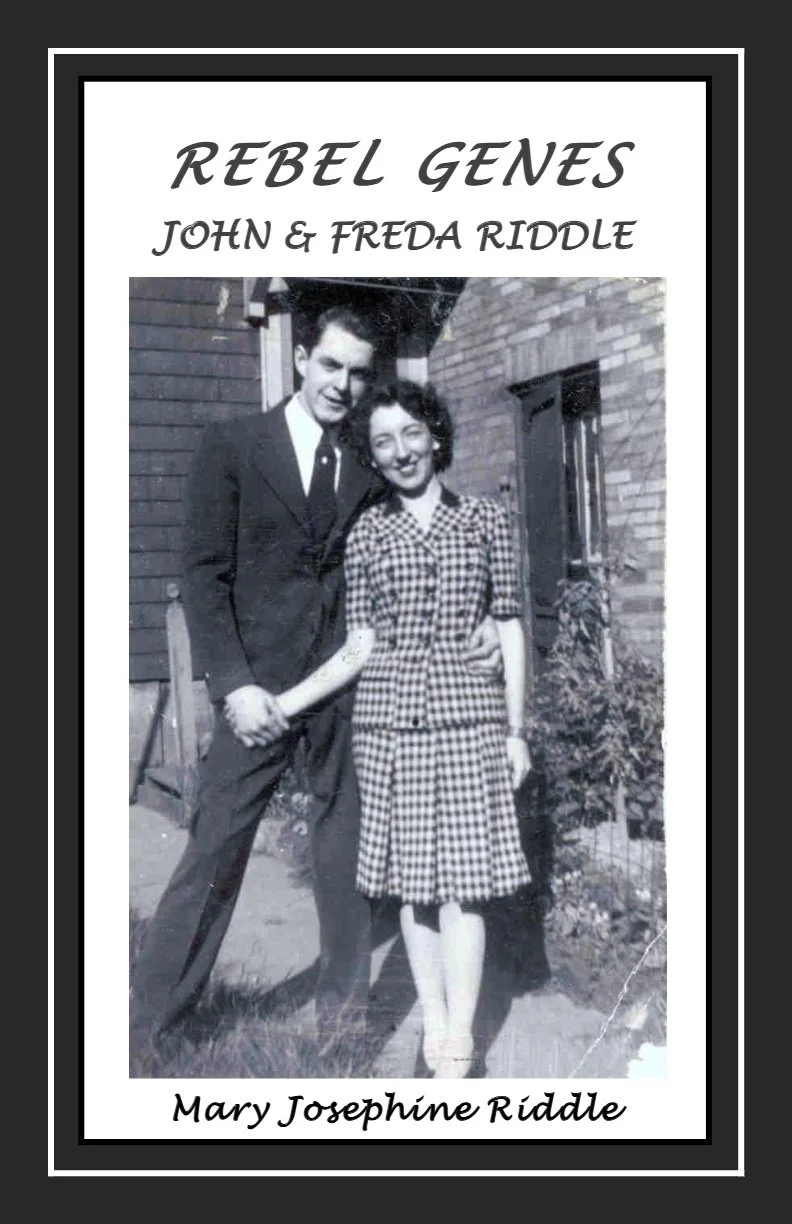
Rebel Genes: John & Freda Riddle
Written by Mary Josephine Riddle Published 2026At a Glance: Genre: Family memoir / social history
Length: 112 pages (including photographs and documents)
Audience: Adult readers interested in personal healing narratives, family history and mid-20th-century Americana.
Overview:
Rebel Genes is a deeply personal family memoir written by Mary Josephine Riddle — the fourth of twelve children born to John Lee Riddle Sr. and Freda Matilda Moessinger Riddle. After more than forty years of research, genealogical study, and personal healing work, Mary has assembled a portrait of her parents' extraordinary lives against the turbulent backdrop of mid-20th-century America.
The book spans three decades, two coasts, a dozen children, and every major fault line of the era: World War II, McCarthyism, the KKK, psychiatric institutionalization, and the welfare state.
The title derives from the author's conviction that John and Freda possessed an instinctive resistance to authority, convention, and institutional control — qualities she argues live on in their descendants as a form of inherited courage.
The Story
The book is organized into three acts. The first section, "In the Beginning," traces John and Freda's courtship in Pittsburgh, Pennsylvania, where both were art students at Carnegie Tech. Their early life together is filled with vivid detail: Freda's survival of a near-fatal car accident before they met, John's brief and mysterious military discharge from the Army Air Corps in 1941, visits to a psychic reader who predicted thirteen children and a life of travel, and their wide-ranging spiritual curiosity — from Unitarianism to Scientology to Christian Science.
All the while having a family of 9 and the grand kidnapping adventure from an orphanage - you have to read it to believe it!
The middle section, "In the Middle," follows the family's 1957 exodus from Pittsburgh to North Fort Myers, Florida — nine children packed into a vehicle, heading south with no safety net.
Florida brings on more adventure and hardship: an encounter with the KKK (documented with a newspaper clipping) first to help and next to burn a cross in their front yard and arrest John, again you have to read it to believe it.
John's ongoing battles with Social Security over disability stemming from his military service, and Freda's role as the steady, if sometimes severe, anchor of a large and restless household.
The final section covers the family's cross-country move to Salt Lake City, Utah in 1965 — this time with ten children and Freda's elderly father in tow — and John's sudden death in 1970 at age forty-nine, which fulfilled his own prediction that he would "either die or move" within five years of arriving.
Strengths
The book's greatest asset is its documentary backbone.
Mary has integrated family photographs, official letters, welfare correspondence, court orders, and Social Security documents directly into the narrative. These artifacts ground what might otherwise feel like a subjective account, lending it historical weight and credibility.
Readers with an interest in American social history will find these materials particularly illuminating — a glimpse into how ordinary families navigated bureaucratic systems that were often indifferent or hostile to them.
John Riddle emerges as a genuinely compelling figure. Intelligent, spiritually curious, and constitutionally unable to trust institutions, he was a man whose instincts — dismissed as paranoia in his lifetime — read with uncomfortable prescience from today's vantage point. His story sits at the intersection of personal struggle and national history in ways that give the memoir an unexpected resonance.
Freda is equally fascinating: a woman of fierce independence, refined tastes born of a modest upbringing, and formidable resilience. The details of her early life — her survival of a traumatic accident, her short-lived first marriage, her seamstress-inspired wardrobe ambitions — paint a portrait of someone who moved through the world on her own terms.
A Note for Readers
Rebel Genes is not a conventional memoir, and readers should come prepared for that.
Mary writes candidly about her belief in spiritual communication with deceased family members, including her brother Jerry and both parents. These experiences are presented as genuine and integral to how the book came into being.
Readers who are open to this framework will find it adds an emotional intimacy to the narrative; those who are not may need to read past it to reach the historical and personal material underneath.
The prose is direct and unpolished in places — this is a personal document written from the inside, not a literary exercise. It shifts freely between memoir, family history, and spiritual reflection. Readers expecting a tightly structured narrative may find it meandering; those willing to follow its organic rhythms will discover real depth.
Who Should Read This
Rebel Genes is written primarily for the descendants of John and Freda Riddle, and for anyone whose family history intersects with mid-century American working-class life. It will resonate with readers who have done their own family healing work, those interested in how ordinary people lived through extraordinary historical pressures, and anyone drawn to stories of unconventional lives lived with courage and conviction.
The book's combination of personal testimony, historical documentation, and spiritual perspective makes it genuinely one of a kind — rough around some edges, but honest in a way that polished memoirs rarely achieve.
Final Verdict
Rebel Genes is a labor of love decades in the making. It is part family archive, part healing testimony, part historical record. Its value lies not in literary perfection but in the courage of the telling — one voice out of twelve, as Mary herself acknowledges, choosing to speak.
For the Riddle family and for readers drawn to unvarnished personal history, it is well worth the read.
— Review prepared March 2026